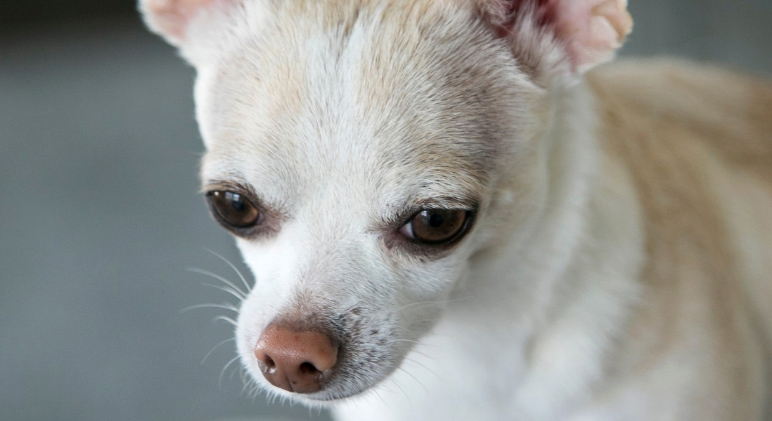
Okay… I want to start this post by saying I’m absolutely obsessed with my Chihuahua’s whiskers. They’re the long, coarse hairs that protrude from his muzzle, jawline, and above his eyes. Aren’t whiskers just adorable? Well, it turns out, they’re not just cute accessories on your dog’s face. Dog whiskers—technically called vibrissae—help our dogs navigate and feel their way through the world.
Think of Whiskers as Feelers
When compared to the fur or hair covering your dog’s body, whiskers are much different. They’re deeply embedded in your dog’s skin, with roots surrounded by a rich supply of blood vessels and nerves, making them highly sensitive to touch. When something is nearby, those nerves send sensory messages to your dog’s brain. Experts say even the slightest pressure applied to whiskers will trigger a neural response so your pooch can get an idea of the size, shape, and speed of nearby objects.
But get this: Your dog doesn’t actually have to touch an object for these sensitive hairs to alert him. According to the AKC: “With intact vibrissae, the dog actually does not have to make physical contact with a surface to know it is there. These special hairs are so sensitive that they also register slight changes in air currents. As a dog approaches an object like a wall, some of the air that he stirs up by moving bounces back from surfaces, bending the vibrissae slightly. The resulting neural response is enough to inform him that something is near well before he touches it.” This is one reason dogs can maneuver well in a dark space.

They Have Their Own Body Language
Whiskers also play a role in canine communication. Dogs use their body language to express feelings and intentions, and whiskers can be a part of this complex system. For example, relaxed whiskers usually indicate a calm and content dog, while whiskers pushed forward or flared out might suggest curiosity or alertness. Conversely, whiskers pulled back can be a sign of fear or submission.
Do You Shave Your Dog’s Whiskers?
If you’re a poodle or cocker spaniel parent then chances are you’re used to taking trips to the groomer and shaving off that excess facial hair. I shave my poodle’s face too. While shaving off a dog’s whiskers won’t cause any pain, it reduces their spatial awareness and can cause them some confusion. Dogs whose whiskers have been removed tend to move slower and tread cautiously when moving around in dark environments (because they no longer have those little sensors to alert them of nearby objects).