
Have you ever watched those athletic dogs on television gracefully yet speedily going through obstacle courses where they weave in between poles, run through tunnels, jump over objects, and walk over seesaws? Well, that’s called dog agility … and wow is it fun!
I’ve always loved watching agility trials on TV and dreamed of doing it with my own dogs. So, I finally asked myself: “What the heck am I waiting for?” Since I was just looking to have a little fun with it, I decided to buy a basic course on Amazon and play around at home. I’ve been practicing with my parents’ dog, Pippa, since she’s a bundle of energy and very playful. I seriously can’t get over how quickly she’s picked up the sport and how much fun we both have when we train. So, I figured it’s time to share!
What Is Dog Agility?
Agility is a sport where handlers guide their dogs through a series of about 14 to 20 obstacles. Think: weave poles, tunnels, jumps, tire jumps, ramps, seesaws, and pause tables. There’s a predetermined pattern for the obstacles and handler/dog teams must get through them all as quickly as possible with the fewest mistakes. According to the AKC, “Agility is a growing dog sport in the United States, with over 1 million entries to the AKC’s Agility program each year.” If your pup has a lot of energy, enjoys being active, and thrives when learning new tricks then he may love this sport.
The Benefits of Agility
For many people, they’re training their dogs to compete in agility trials. For others (like myself), it’s just a fun hobby. Regardless of your motives, some benefits of dog agility include:
- Great exercise for your dog (and you!)
- Wonderful mental stimulation for your pup
- Enhances the bond between you and your dog
- Increases communication skills between you and your dog
- Improves off-leash reliability
- You and your dog will have a blast!
Getting Started
Dogs usually start competing in agility trials between one to two years old, and can get started with training a little before that. Since a puppy’s bones are still developing (they’re softer, spongier, and not as dense as an adult dog’s) and their growth plates aren’t closed yet, consult with your veterinarian beforehand to avoid injury.
Before you head into the agility ring with your canine companion, work to master the basic commands, like look at me, sit, stay, come, lie down, heel, etc. This will make your time tackling the obstacle course much easier.
Classes & Home Courses
If you’re looking to (one day) compete in agility trials – or you just don’t have enough room for a course in your home – look into agility classes or groups near you. The United States Agility Association offers a directory for agility groups in each state. If you don’t find one listed in your area, you can also do a quick Google search to find a trainer or group near you.
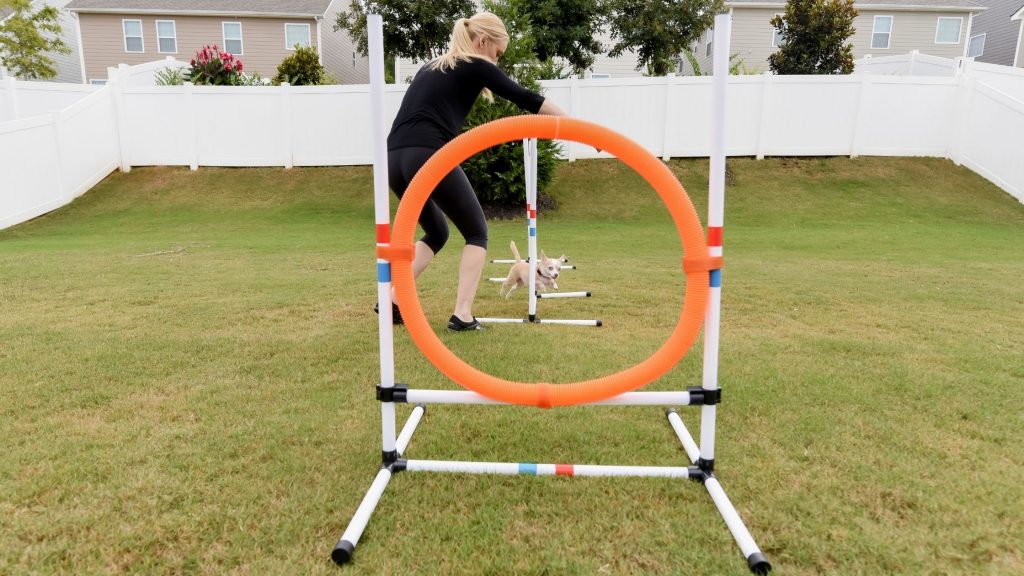
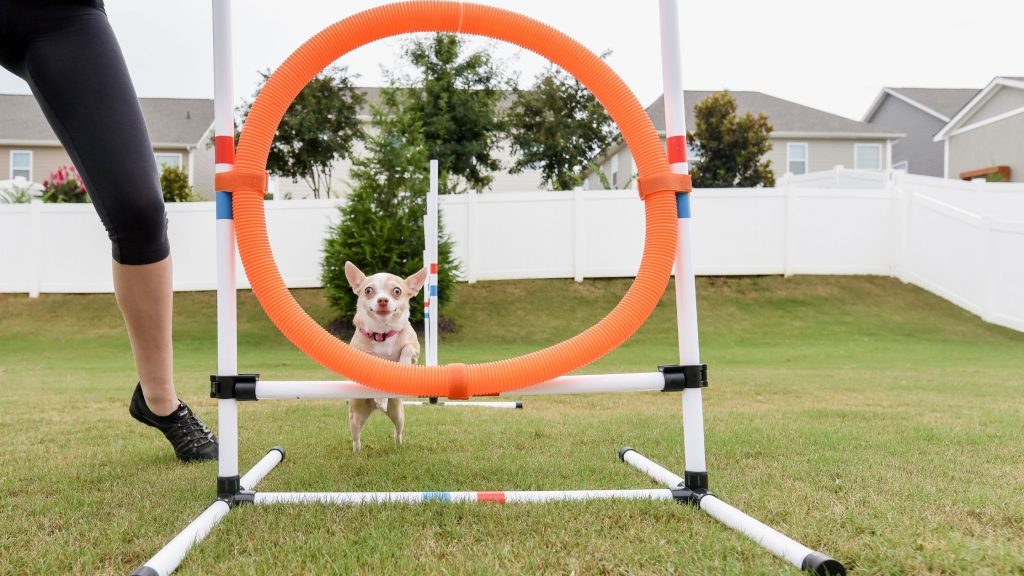
If you’re just out to have some fun, you can either attend classes, buy your own course online (there are plenty of options on Amazon), or get crafty and DIY your own obstacles. You can make jumping poles out of PVC piping, use a long cardboard box as a tunnel, or try gardening stakes as weaving poles!
While I do plan to attend classes in the future, right now, Pippa and I are just having fun at home. I set up our course in my living room and occasionally take it out into the backyard for more room and to test her skills with added distraction.
Some Popular Dog Agility Obstacles
Tunnel
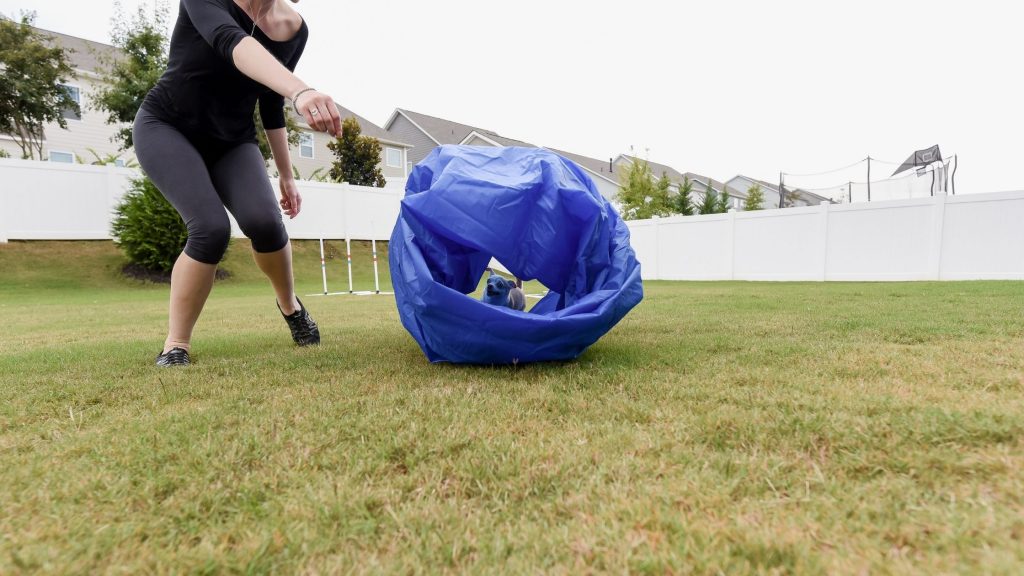
Tunnels are one of the easiest obstacles to teach. Grab a partner and try the following:
- Start off with a short, straight tunnel. Oftentimes, agility trial courses will put a bend into the tunnel. But, when you’re just starting out, it’s important for your pup to see through to the other side.
- At one end, have your partner stand with your dog near the tunnel’s entrance. You’ll stand on the other end, ready with some tasty treats!
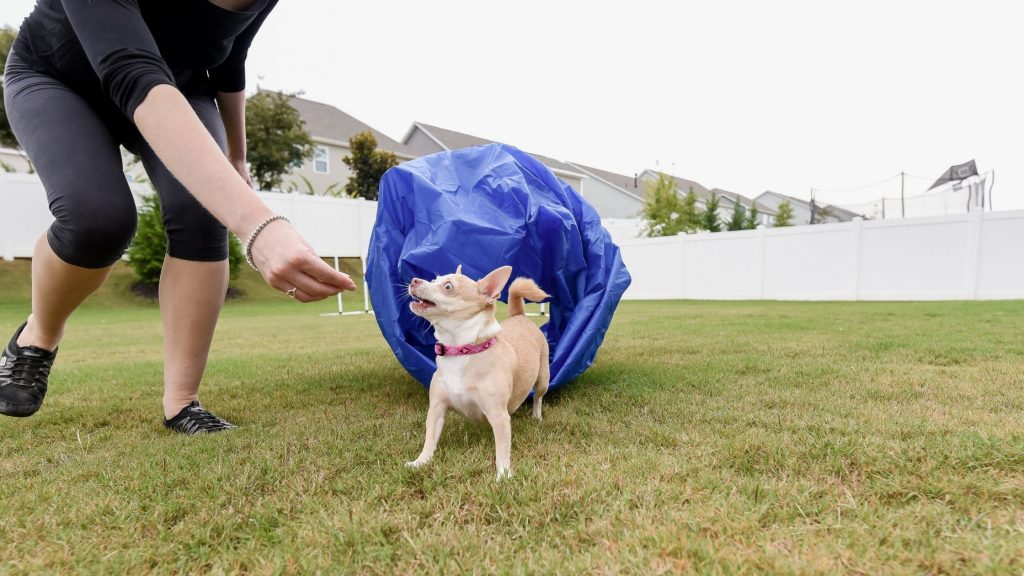
- Rather than standing directly in front of the tunnel’s end and blocking the light, stand slightly off to the side and simply peek your head inside the tunnel. Then, lure your pup into the tunnel by calling out his name and showing him the treat.
- Once your dog reaches the end and walks out of the tunnel, offer lots of praise and the tasty treat.
- Repeat these steps. Once your dog seems comfortable, start adding the “Tunnel” command before your pup goes through.
Weave Poles
Weave poles are a series of 6 to 12 vertical poles that are spaced out along a straight line. Dogs must enter to the right of the first pole and weave through the others without missing a pole.
There are a few methods for teaching a dog to go through the weave poles. Your trainer will help determine what’s best for your dog, but here is an overview of the various methods:
Channel Method
The goal here is to start off with staggered poles and let your dog walk straight through. That’s right — straight through. With this method, your dog won’t actually weave in the beginning. Rather, he’ll walk in a straight line with some poles to his right and some to his left. Then, once he reaches the end, he’ll get a reward. As your dog gets more comfortable, you’ll gradually move the poles closer to the center, forcing your dog to bend his body and begin the weave action.
The Channel method encourages great speed at an early stage of training!
Weave-A-Metric (WAM)
In this method, poles are angled outward in alternating directions. Think of a V shape (first pole to the left, second to the right, etc.). At first, the poles are tilted extremely wide, making them almost parallel to the ground, and the dog is encouraged to run the full length of the set. As the dog becomes more comfortable, the poles are slowly lifted, bringing the tops closer and closer together until all the poles are vertical.
2×2 Method
With this method, your dog will begin with just one set of two poles (vs a full set). Once the dog flies through the first pair of poles with confidence and ease – from all angles – a second set of two poles is introduced. They’re typically placed a short distance from the first pair. As the dog becomes comfortable with the individual pole sets, they’re moved closer together, eventually meeting regulation.
With this method, dogs thrive at finding the weave entry.
Lure Method
When using this method, you’ll use a treat to literally lure your pup in and out of the weaving poles. It’s a bit of a training cheat and many experts don’t recommend this method, as it doesn’t teach the dog independence, fluidity, and speed. But, since the weave pole set that I purchased has a fixed base, doesn’t let me change up spacing to create a channel, and I’m simply looking to have some fun with my pups (not compete), I taught Pippa to weave using the lure method. I must say: She picked up on the weave poles quickly, so it worked for us! Here’s what we did:
- I stood on one side of the weave poles and my mom (AKA also Pippa’s mom) stood on the other side. We each had treats.
- To begin, I showed Pippa the treat and lured her through the first set of poles. Once she reached me, I gave her the treat. Then, my mom lured her through the next set of poles. Once Pippa reached her momma, she got the next (very small-sized) treat. We repeated this process until she got to the end of the weaving poles.
- After about three or four times luring Pippa through the poles together, my mom stepped back. It was just me and the Pip. I held the treat with one hand and kept it close to her nose (as if the treat and her nose were magnets). As I weaved my hand in and out of the poles, Pippa followed. Each time she crossed through a set of poles, I gave a verbal cue: “Weave.” At this point, I didn’t give her the treat until she reached the end of the poles.
- We repeated that process for about a week, picking up speed each day. Now, I simply stand near the weave poles with a treat and give her the verbal cue. She knows what to do!

Jumps
- In the beginning, keep the bar super low! Try just a few inches off the ground for large dogs, and an inch or so for small breeds. You’ll slowly raise the bar as your dog becomes more and more comfortable.
- With your dog on one side of the obstacle and you on the other side, lure your pup over with a treat or toy. When I first started jumps with Pippa, we practiced this in a narrow hallway, so she needed to jump over the pole to get the treat rather than just walking around it. As your dog gets the hang of jumping, begin adding the verbal cue “Jump”
- Another training tip is to stand on the same side as your dog, toss a treat or toy over the bar, and have your dog jump over to retrieve it.

Competitions
Any purebred or mixed-breed dog can participate in agility. Dogs must be 15 months or older to compete, in good health, and up-to-date on vaccinations. HERE is a digital copy of the regulation guidebook from the AKC!