
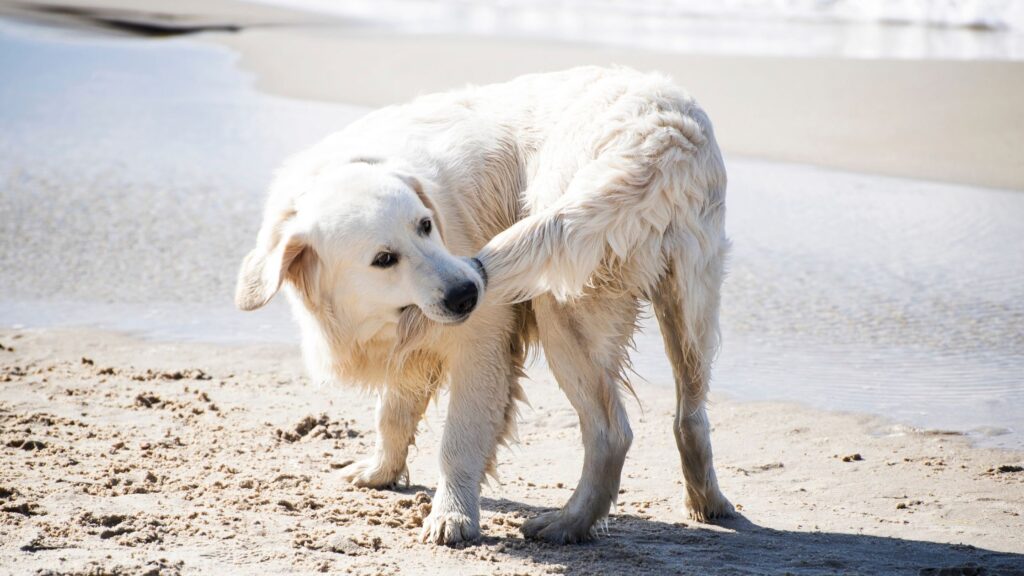
It’s like the popular chant: “Round and round and round she goes. Where she stops nobody knows!” How funny is it to kick back and watch a dog run in tight circles, on a mission to capture their tail?! It’s certainly one of the many canine behaviors that make us laugh. But, have you ever wondered why the heck your pup suddenly realizes she has a tail and feels the urge to chase it? Read on to find out!
Boredom-Buster
Is your pup left alone for hours a day, just chillin’ on the couch? When you are home, do you usually get busy with other tasks while your pup just lies on their bed? Well, dogs can get bored. And, when they aren’t physically or mentally stimulated, they find ways to amuse themselves. Often, that amusement comes in the form of barking and destruction. But, other times, dogs may get the zoomies or chase their tail.
Round and round!
Chasing tail is a fun way for your pup to bust-boredom and expend his excess energy. If you suspect your pup is bored then it’s time to boost their stimulation by:
- Busting out some doggy puzzles (see my favorites HERE)
- Letting them play with a food-filled KONG (see my 3-step KONG stuffing method HERE)
- Playing a game of fetch
- Working on some new tricks
- Taking a leisurely stroll around your community and letting your pup sniff around
- Trying out doggy sports, like agility or swimming! (see my intro to agility HERE)
In general, make sure your pup is getting enough attention and stimulation.

Attention-Seeking
Here’s another motive behind the amusing behavior: If you often sit nearby laughing at the behavior, your dog may start to like the extra attention and begin chasing his tail when seeking attention!
Could Tail-Chasing Be a Sign Something is Wrong?
While tail-chasing is normally nothing to worry about, if it’s constant, paired with other odd behavior, and/or you notice your dog trying to chew at his rear-end then it’s time to schedule a visit with your veterinarian. It may be a sign of flea allergy dermatitis or anal gland problems.
Can Tail Chasing Become a Compulsive Behavior?
Just like people, dogs can develop obsessive-compulsive disorder (OBD). But, rather than opening and closing cabinet doors or washing their hands a million times, dogs may turn to tail chasing. According to VCA Hospital:
“Dogs with OCD chase and chew their tails incessantly and it becomes a compulsive habit. In fact, some injuries don’t heal because the dog continues to traumatize the tail. Breaking the cycle of self-trauma requires a little effort on the part of the dog and the dog owner.”
If your dog chases his tail so often that it’s becoming an issue, consult with an animal behaviorist and work together to come up with a training solution.