

I’ve gotta say: Dogs are amazing! They’re loving, loyal, and, as the saying goes, they’re man’s best friend. While all dogs bring special energy, some are trained to do incredible things. Read on to discover 8 types of assistance dogs, the many things they do for their human companions, and the training they go through.
What it Takes to Raise an Assistance Dog
First things first: Many organizations have breeding programs where they breed their own puppies. When the pups reach 8 weeks of age, they typically move into a foster home with a “puppy raiser.” Puppy raisers aren’t trainers. Rather, they’re regular people like you or me who’ve applied, been screened, and met the organization’s specific requirements.
A puppy raiser’s job is to give the puppy a positive upbringing in his first year or so of life. Additionally, they teach the puppy to:
- Have good manners at home and away from home
- Be confident and calm
- Master obedience training
- Become socialized with humans, as well as other house pets
- Expose him to daily living at home as well as outside
- Be completely housetrained
Depending on the organization, the puppy will live with the puppy raiser for 12 to 18 months. After that, he’ll return to the organization and begin working with professional trainers, who will continue reinforcing routine training while adding specific task training. During this time, they’ll learn the necessary tasks for the type of assistance dog they’ll become.
10 Common Breeds Used as Assistance Dogs
Of the many breeds that could qualify as service dogs, according to the United Disabilities Services Foundation (UDSF), these are the breeds most commonly seen doing this work:
- Labradors
- Golden Retrievers
- German Shepherds
- Poodles
- Border Collies
- Boxers
- Great Danes
- Bernese Mountain Dogs
- Portuguese Water Dogs
- Pomeranians
The common thread: They’re are all intelligent, quick learners, love to work, want to please, loyal companions, friendly, calm, large, and strong – except for the Pomeranian, that is!
Even though they are small, Pomeranians are perfect to work as medical alert dogs, hearing dogs, mental health dogs, and in jobs that don’t require the muscle of a larger dog. These little guys don’t require a lot of exercise and enjoy being lapdogs, which provides comfort and constant companionship to their human as well.
8 Types Of Assistance Dogs
Guide Dogs
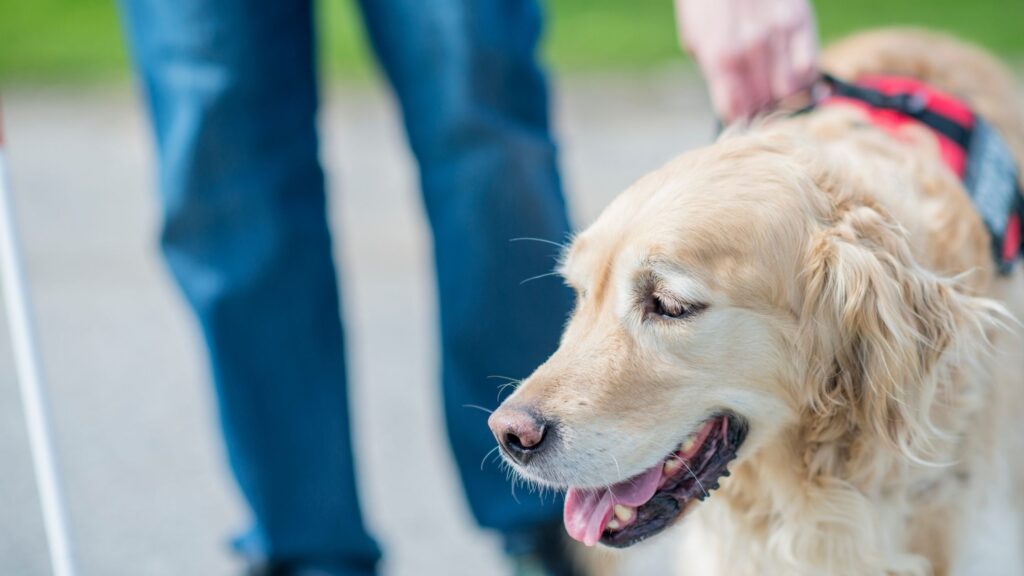
Guide Dogs (AKA seeing-eye dogs) are trained to guide the visually impaired. They open up a world of opportunity and possibilities for blind people.
- They promote independence, confidence, dignity, and provide emotional support.
- Enable their handler to venture out and safely navigate public areas. They assist their handlers with crossing streets safely, avoiding obstacles and unexpected challenges, alerting their partner to changes in elevation, etc.
- Provide companionship. A Guide Dog and his handler build a bonded relationship – a true partnership – one of total trust. For the team to work successfully, the handler and dog have to remain alert to changing cues in their surroundings, whether at home or out in the public arena.
- Although not required to wear a service vest, they do wear a special harness equipped with a built-in bar for their handler to hold on to.
Get this: Seeing-eye dogs are known to assist humans as far back as the first century AD, as evidenced by a mural found buried in the ruins of the Roman Herculaneum. But, formal training didn’t begin until the end of the 1700s.
Hearing Dogs
Hearing Dogs are trained to serve the hearing impaired or deaf, making their lives safer. Always on duty, these dogs alert their partner to everyday sounds, like an alarm clock, timers, doorbell, telephone, as well as emergency sounds like the smoke detector, fire alarm, etc.
But it doesn’t stop there. A silent world can be a lonely world. Hearing dogs offer companionship, emotional support, confidence, independence, and comfort.
Watch them in action in the video below.
Diabetes Alert Dogs
These dogs can be a lifesaver for the diabetic whose blood sugar levels are too high or too low (and doesn’t know it). When a diabetic’s blood sugar levels become too high or too low, chemicals are released into the body. The chemicals have distinctive smells that can be detected through a person’s breath and sweat. Thanks to the superior sniffing ability of canines, Diabetic Alert Dogs can be trained to sniff out and recognize these odors. If he does, the dog would alert the handler by either pawing at him, nudging, licking, barking, and, in the case the handler was asleep, the dog would wake him. Some dogs are even trained to alert another person to come and assist.

Seizure Dogs
Seizure Response Dogs
According to The Epilepsy Foundation:
“A seizure dog is a dog that has been trained (or has learned) to respond to someone who has epilepsy.” “Seizure Response dogs are trained to respond to a person already having a seizure – not predict a seizure.”
Response dogs,
- Bark to summon help
- Stay with the person
- Protect the person having the seizure from injury by lying next to them
- Lie on the ground to soften the blow in case the person were to fall
- Trigger emergency alarm devices like pressing a button to call 911
- May bring medication or a telephone to the person as the seizure subsides
Seizure Alert Dogs
These dogs alert the person of an impending seizure. There’s a lot of controversy surrounding seizure alert dogs. Some say dogs can’t be trained to reliably alert someone before a seizure, and others argue they can. Although the jury is still be out on that one, the service dog training organization, 4 Paws For Ability in the U.S says they have been very successful in training the alert dogs.
“The one thing scientists have been able to come to an agreement on is that the dog smells a chemical body change on the person just prior to and during a seizure. While many believe it is not possible to train seizure alert here at 4 Paws we can and do!
And they’re not alone, This is what Support Dogs in the U.K. says about their training program and their seizure alert dogs,
“Our seizure alert dogs are trained to provide a 100% reliable warning up to 50 minutes prior to an oncoming epileptic seizure, enabling clients to get to a place of safety, and enabling them to live more independently.“
Mobility Assistance Dogs
Mobility Assistance Dogs increase the quality of living for people with impaired mobility. They’re trained to perform tasks such as:
- Opening automatic doors
- Ringing for the elevator
- Providing walking support
- Pulling a wheelchair up a ramp
- Retrieving things from the floor
- Bringing their handler needed objects
- Turning the lights on and off
Mobility Assistance Dogs Serve people with many different types of disorders, such as:
- Arthritis
- Brain, Spinal, and Neurological Disorders
- Impaired balance, coordination, gait, and vertigo
According to Canine Partners For Life,
“By law, someone requesting a mobility service dog must have a developmental, physical or psychiatric disability. Whether you have difficulty upholding your balance, walking from one place to the next or need medical assistance during emergencies, you can partner with an assistance dog.”

Psychiatric or Mental Health Service Dogs
Psychiatric Assistance Dogs (PAD) work with people who’ve been diagnosed with a mental health or psychiatric disorder. To qualify for a PAD, one must have a documented disability and the dog has to be specially trained to ease that disability.
The dogs can assist people with depression, anxiety, panic attacks, phobias, obsessive-compulsive disorders, schizophrenia, bipolar disorder, as well as post-traumatic stress syndrome (PTSD).
For these people, daily life can be a struggle. Routine activities like self-care can be difficult to manage. Simple things like leaving the house, being in public, hearing sudden noises, or re-entering a room could spark intense anxiety. Studies have shown these dogs have positive and calming effects on their handlers. Examples of common tasks performed by PAD’s include:
- Room Searches – for people afraid to re-enter their rooms or homes
- Interrupt and Redirect – for some with an obsessive-compulsive disorder
- Summon Help – for a person who is having a flashback or is otherwise disoriented
- Guide Disoriented Handler ~ from flashback or an out-of-touch state
- Retrieve medications
This list can be endless, depending on what the handler suffers from.
*Note: It should be noted that Psychiatric Assistance Dogs should not be confused with Emotional Support or Therapy Dogs. PAD are service dogs (not pets) trained to perform tasks specific to a person’s disability and are recognized and protected under the American Disabilities Act, (ADA). Emotional support dogs are pets and they provide emotional support to their owners just by being there. Therapy dogs are also pets. They provide comfort to people in nursing homes, hospitals, and various other settings when their owners volunteer to go and visit.
Allergy Detection Dogs
Allergy sufferers have unique needs. They can be totally fine one minute, then suddenly be exposed to an allergen and boom — life-threatening situation. Allergy Detection Dogs are trained to sniff out certain odors that people (mainly children) are allergic to. Two of the top foods known to spark allergic reactions in some people are peanuts and gluten. Thanks to super canine nose skills, dogs can be trained to pick up on certain scents so they can alert their owner before ingesting something potentially dangerous. Dogs of this type will often accompany children to school, which can help put mom and dad’s mind at ease.

Autism Support Dogs
Autism support dogs are trained service dogs who assist autistic children. Having a support dog has been shown to increase an autistic child’s quality of life by increasing confidence, independence, communication skills (verbal and non-verbal), and social interactions.
Since some autistic children have been known to roam off at times, the dogs are trained to prevent this behavior. But, in case they do get away, the dog is trained to track them. These dogs are the child’s constant companion and are there for the child in a time of need. They provide a sense of emotional support for the children and the family as well.
In Need of an Assistance Dog?
If you, or someone you know, is in need of an assistance dog, here are some reputable resources that have been around for decades.
The Seeing Eye – Founded in 1929, is the oldest school and provider for guide dogs.
Guide Dogs For The Blind – Founded in 1942 and is another leading provider of guide dogs. Both of these organizations offer services throughout the United States and Canada. Assistance Dogs International (ADI) – Founded in 1986, serving internationally, they are a coalition of non-profit organizations that raise, train, and place all types of assistance dogs.