

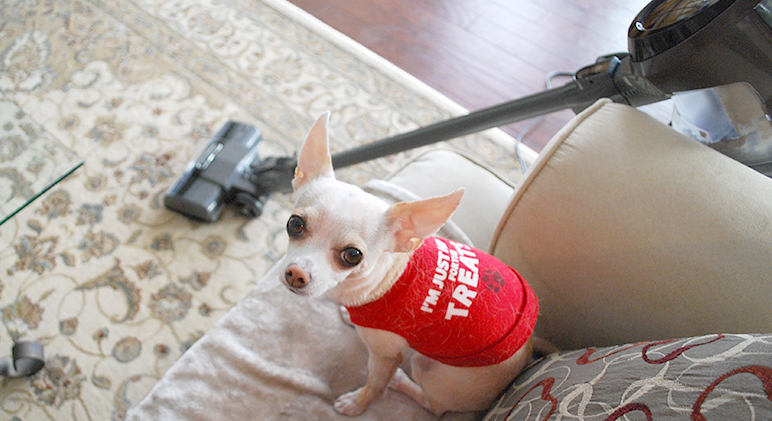
Does your dog get scared when he hears a loud noise? A sudden clap of thunder or booming fireworks display sends many dogs running for a safe hiding spot—curled under the bed, buried beneath the covers, or burrowed behind furniture. Or maybe your dog thinks the noisy vacuum is an attacking monster (that big, mean, cleaning machine is my Chihuahua’s arch-enemy)! So why do they get so scared? It’s partly the initial shock and not understanding what certain sounds mean. But it’s also the result of your dog’s ears being more sensitive to sound than yours!
Understanding Dog Hearing
Have you ever noticed dogs are the first to know when a car pulls into the driveway, if someone is walking down the street, or if someone is coming to the front door? You may have guessed your dog’s hearing is better than yours … and you’re right! Dogs can hear sounds about 4 times better than humans. Something you might hear at 25 feet away, your pooch will likely hear at about 100 feet away.
Additionally, a dog’s frequency range of hearing is much greater than us humans. Frequencies—AKA high or low-pitched sounds—are doubled for Fido. A person can hear frequencies of 20 to 20,000 Hz, while your dog can hear frequencies of 40 to 60,000 Hz. Think of a dog whistle! Blow it and you hear nothing. But your pup’s ears will perk right up upon the first blow. Loud, high-pitched frequencies can be very uncomfortable for your pooch.
Dog Hearing by Breed
Some dog breeds hear better than others—it all depends on how the ears fall. Dogs with ears that stand up, like a Chihuahua or German Shepherd, can hear a little better than a dog with floppy ears, like a Poodle or Shih Tzu. That makes sense, right? If your dog has floppy ears then his/her ear canal is covered, blocking the sound!

Why Do Dog Ears Move When They’re Listening?
Dogs have 18 muscles in their ears that enable them to move in the direction of the sound. Plus, they can hear out of each ear independently, allowing them to isolate exactly where a sound is coming from. How cool is that?! A human, on the other hand, hears sounds with both ears at once and only has two sets of muscles. Have you ever tried to move your ears? Even if you did get a little wiggle out of them, you are no match for little Fido. FYI a cat has 32 muscles in their ears and can hear even better than Fido.
Dog Ears Tell You What Your Dog is Thinking
One way to read your pooch’s body language is through his ears. So pay close attention to your dog’s ear position because body language, in general, is a great way to really get in touch with your pooch and learn to understand him better. A few decoded ear positions:
- Neutral ears = The dog is relaxed.
- Perked-up ears = He’s heard something and is on alert.
- Perked-up ears with lots of movement = He’s trying to figure out where the sound is coming from and what the current situation is.
- Ears back and flattened against their head = He may be feeling frightened or submissive.
- Ears up and forward = The pup may be on alert because this is a sign of aggression.
Quick Facts About Dog Hearing
- Puppies are born deaf and don’t begin to hear until they’re about 3 weeks old.
- Just like humans, with age dogs can become hard of hearing.
- A cat has 32 muscles in their ears and can hear even better than Fido.
- Even at night when we’re all sleeping, your dog can still hear the clock ticking, that text coming in, and the cars zipping by outside. So the next time Fido wakes you up by barking in the middle of the night, he’s just trying to let you know he hears a noise.