The U.S. Food and Drug Administration warns pet parents to stop feeding certain lots of Darwin’s Natural Selections Pet Food. This comes after FDA samples of five Darwin’s Natural Pet Products raw cat and dog food made by Arrow Reliance, Inc. tested positive for Salmonella, and a sixth FDA sample tested positive for Salmonella and Listeria monocytogenes (L. mono).
The Foods in Question
Arrow Reliance Inc. makes the food in question. See the list of affected lots below. Note: According to the official FDA notice, “The FDA recommended that Arrow Reliance, Inc. recall all six lots of product. To date, the firm has not recalled the affected products and could continue to distribute them. Therefore, FDA advises consumers to keep checking Darwin’s Natural Selection Antibiotic & Grain-Free products for the affected lot numbers prior to feeding to pets.”
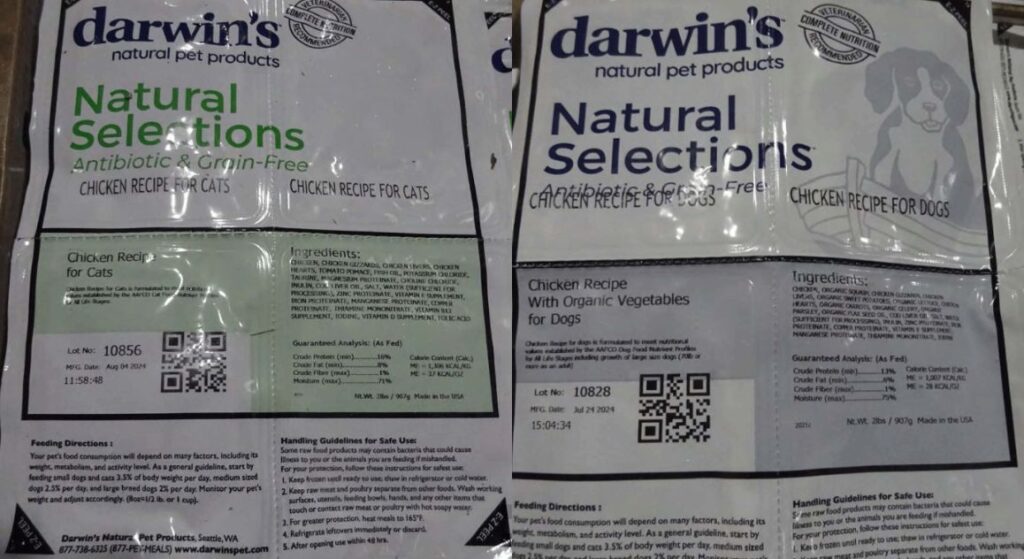
- Darwin’s Natural Selections Antibiotic & Grain-Free Chicken Recipe for Dogs. Lot No: 10828 MFG. Date: Jul 24, 2024
- Darwin’s Natural Selections Antibiotic & Grain-Free Chicken Recipe for Dogs. Lot No: 10844 MFG. Date: Jul 30, 2024
- Darwin’s Natural Selections Antibiotic & Grain-Free Chicken Recipe for Dogs. Lot No: 10887 MFG. Date: Aug 12, 2024
- Darwin’s Natural Selections Antibiotic & Grain-Free Chicken Recipe for Cats. Lot No: 10832 MFG. Date: Jul 25, 2024
- Darwin’s Natural Selections Antibiotic & Grain-Free Chicken Recipe for Cats. Lot No: 10856 MFG. Date: Aug 04, 2024
- Darwin’s Natural Selections Antibiotic & Grain-Free Chicken Recipe for Cats. Lot No: 10890 MFG. Date: Aug 13, 2024
Affected products are sold in frozen 2-pound packages and generally sold online through a subscription service. The product lot codes are printed on the front of the lower left unit of the package of food.
Feed This Food?
If you have these lots of pet food from Darwin’s Natural Pet Products, you’re advised not to feed them to your pets. Instead, throw the food away in a secure container where other animals, including wildlife, cannot access it. Do not donate the food. Additionally, to keep you and your pets safe, you’re asked to thoroughly clean and disinfect any bowls, utensils, storage supplies, or surfaces the food or pet had contact with. A few areas that may easily go overlooked while cleaning are the inside of your refrigerator/freezer and pet bedding.
About Salmonella
Salmonella is a bacterium that can cause illness and death in humans and animals, especially those who are very young, very old, or have weak immune systems. People infected with Salmonella can develop diarrhea, fever, and abdominal cramps. Most people recover without treatment. However, severe cases may require hospitalization. If you develop any symptoms of Salmonella infection, consult your health care provider.
Pets infected with Salmonella don’t always display symptoms. Signs can include lethargy, decreased appetite, fever, abdominal pain, diarrhea or bloody diarrhea, and vomiting. Infected but otherwise healthy pets can be carriers and infect other animals or humans. It’s important to note that infected pets can shed the bacteria in their feces and saliva without showing signs of being sick. If your pet has consumed the recalled product and has these symptoms, please contact your veterinarian.
About Listeria
Listeria monocytogenes is a bacterium that can cause illness and death in humans and animals, especially those who are pregnant, very young, very old, or have weak immune systems.
For Humans
Healthy people infected with Listeria monocytogenes may experience some or all of the following symptoms: nausea, vomiting, aches, fever, and diarrhea. Listeria monocytogenes infections can spread through the bloodstream to the nervous system (including the brain), resulting in meningitis and other potentially fatal illnesses.
For Pets
According to the FDA, L. mono infections are uncommon in pets but are possible. Customers should keep an eye out for symptoms such as weakness, lethargy, diarrhea, vomiting, fever, nervousness, muscular and respiratory signs, depression, shock, and possibly death. According to the FDA, animals may become carriers and serve as potential sources of infection to other animals. Contact your veterinarian if your pet has consumed the recalled product and has these symptoms.