
Take a walk down the food aisles of your local pet store or do a simple Google search for ‘dog food’ and you’ll quickly realize there are so many choices! With too many options, the process of picking out the perfect food for your precious pup can feel like a daunting task.
The pet food industry rakes in billions upon billions of dollars annually … and each manufacturer wants a piece of that pie. So, in an effort to make their foods and treats appear more desirable than the next, they get pretty clever with marketing. The images and wording on food bags can be quite misleading, filled with meaningless buzzwords that make pet parents feel like certain foods are way healthier than they are.
Keep reading for some important things to watch for when dog food shopping.
First Ingredient (It’s Not Always As Impressive As You Think)
The Association of American Feed Control Officials (AAFCO) is the organization that sets all standards for pet food — including nutrient ratios, ingredient allowances, and the terminology that’s allowed on the packaging. One requirement set forth by AAFCO: All pet food manufacturers must list ingredients in order of weight. So, naturally, you may think the first ingredient is the most prominent. But, not so fast!
These labels are created before the product is cooked and processed. Since meat holds a lot of water, it weighs significantly more prior to cooking. So, if you spot a food label that lists meat first and then various grains as the second and third ingredient, there is likely more grain in the food than meat.
This brings us to another sneaky marketing tactic that helps artificially boost meat into that #1 spot …
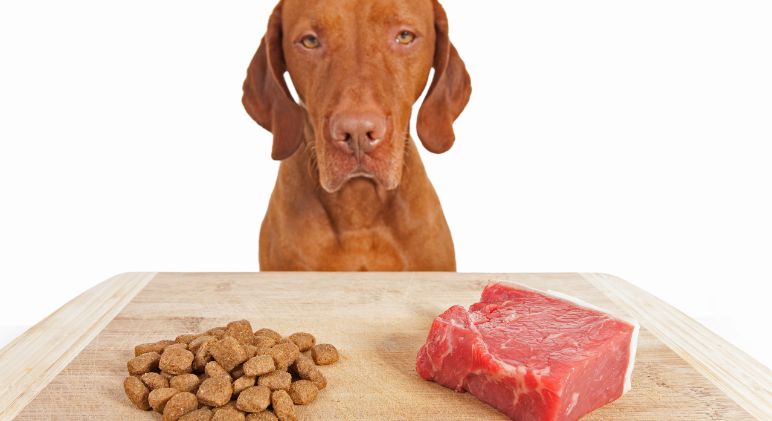
Ingredient Splitting
Another common way marketers sneak meat into that #1 spot is by deceptively dividing up ingredients. For example, you may see a label that looks like this: chicken, chicken meal, brown rice, white rice, rice gluten, rice bran, split peas, pea protein, potato, potato starch. But that same label could also look like this: rice, peas, chicken, potatoes. That second version isn’t as appealing, right? I wrote an entire article on the practice of Ingredient Splitting, which you can read HERE.
Misleading Wording
If a dog food bag shows photos of healthy hunks of meat and fresh vegetables, that doesn’t necessarily mean those ingredients are packed inside.
- Foods labeled with words “Dinner,” “Nugget,” or “Formula” only have to contain 25% actual meat.
- Foods labeled “with chicken,” “with beef,” or “with” any other protein only have to contain 3% meat.
- “Flavor” is perhaps the worst term. Dog food bags labeled with the word “Flavor” don’t have to contain any real meat at all.

What Does “Natural” Even Mean?
Consumers love the word “Natural”. But, when it comes to pet food, this word doesn’t mean what you think it does. Actually, it’s a pretty useless term. Here is the formal definition of “Natural” from AAFCO. Read it carefully and don’t miss that last line!
“A feed or ingredient derived solely from plant, animal, or mined sources, either in its unprocessed state or having been subject to physical processing, heat processing, rendering, purification, extraction, hydrolysis, enzymolysis or fermentation, but not having been produced by or subject to a chemical synthetic process and not containing any additives or processing aids that are chemically synthetic except in amounts as might occur in good manufacturing practices.”
The Issue With “Complete”
You’ll often see the words “Complete and Balanced” on pet foods. But, what the heck does that mean? According to AAFCO, the term “complete” means the product contains all of the nutrients it’s supposed to. But that doesn’t mean those nutrients come from quality sources!